Aviation Training Enters New Era at Texas A&M-RELLIS
•
min. read
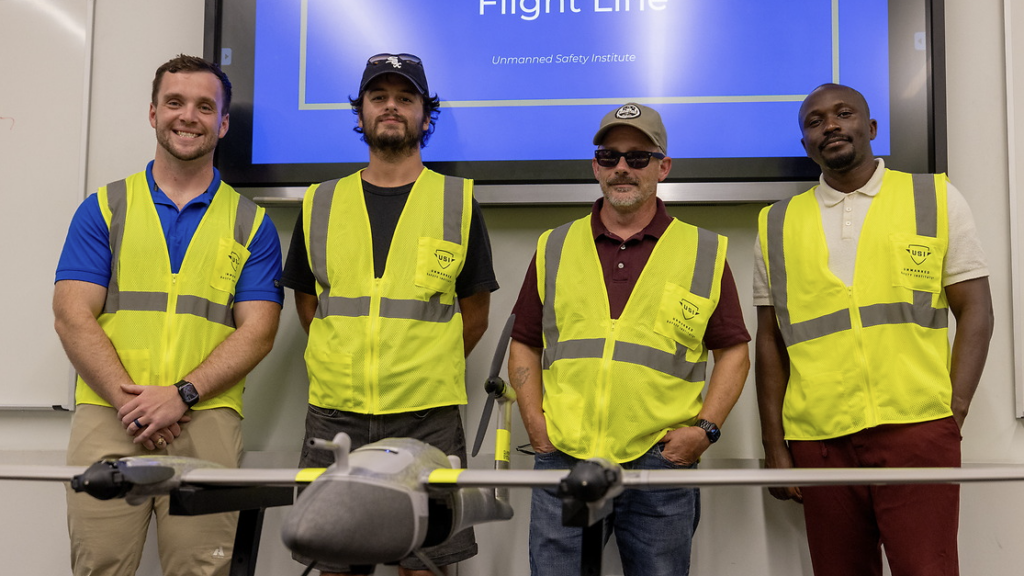
First Professional Remote Operator class graduates at former Bryan Air Force Base
BRYAN, Texas — More than 80 years after military aviators trained at Bryan Army Air Field, aviation training is taking a new form on the same historic ground.
Texas A&M-RELLIS and the Unmanned Safety Institute on Thursday celebrated three graduates of the first Professional Remote Operator Program offered through the new partnership.
The students completed 12 weeks of online instruction before gathering at Texas A&M-RELLIS from Aug. 18-20 for three days of in-person instruction and hands-on flight training.
Activated in 1943, Bryan Army Air Field housed a U.S. Army Air Forces instructors’ school assigned to develop a standardized system of instrument flying. The installation was later reactivated as Bryan Air Force Base, where instructors included future astronauts Edwin “Buzz” Aldrin and Virgil “Gus” Grissom.
“More than 80 years ago, this airfield prepared military aviators to serve the nation,” said John Barton, executive director of Texas A&M-RELLIS. “Today, RELLIS is once again preparing aviation professionals for a changing economy, where unmanned aircraft systems are becoming essential tools for employers across Texas.”
The Professional Remote Operator Program goes beyond conventional preparation for the Federal Aviation Administration’s Part 107 examination. Students learn how to conduct safe flight operations and help organizations establish and manage professional drone programs.
Participants who complete the certification requirements can earn an FAA Remote Pilot Certificate under Part 107, USI Visual Line of Sight Operations Ground Certification at Safety Level 3, USI Visual Line of Sight Operations Flight Certification at Safety Level 4 and a Texas A&M-RELLIS Certificate of Completion.
“We are honored to partner with Texas A&M – RELLIS in bringing aviation-grade UAS education and training back to a campus with such a powerful aviation legacy,” said Garrett Klinger, Program Manager and Instructor for USI at Texas A&M – RELLIS. “This inaugural graduating cohort represents exactly what the future of unmanned aviation requires: skilled, safety-minded professionals prepared to contribute on day one. We congratulate these graduates on their achievement and are proud to support Texas A&M – RELLIS as it prepares the next generation of unmanned and electric aviation leaders.”
“Employers need people who can do more than pass an FAA exam,” said Brad Hall, director of operations at Texas A&M-RELLIS. “They need professionals who understand how to operate safely and help manage a successful drone program. These graduates now have that foundation.”
The first graduating class included Toheeb Agboola, Hart Bassana and Geoff Hamilton.
“I entered the program to get my official license and have learned drone maneuvers to use in my career as a farmer, like spraying pesticides and herbicides and using camera controls to monitor crops,” said Agboola.
The next Professional Remote Operator Program begins Sept. 8, and new classes are scheduled to begin monthly. The enrollment deadline for the September class is Sept. 1.
For program information or to enroll, visit https://www.flyusi.org/fast-track-drone-program-at-texas-am-rellis.
Broadcast-quality b-roll and photographs: Click here to download
About The Texas A&M University System
The Texas A&M University System is one of the largest and most impactful higher education systems in the country, with an annual budget of $9.1 billion. Its statewide network includes 12 universities, a comprehensive health science center, eight state agencies, Texas A&M–Fort Worth and the Texas A&M–RELLIS Campus. The A&M System also plays a direct role in U.S. national security as a member of the teams that manage and operate Los Alamos National Laboratory and the Pantex Plant for the U.S. Department of Energy’s National Nuclear Security Administration. The A&M System serves nearly 175,000 students and reaches millions more through research, service and outreach programs each year. With nearly $1.6 billion in annual research expenditures, the A&M System fuels innovation, supports communities and drives Texas’ economy forward.
Media Contact:
Chris Bryan
Vice Chancellor of Marketing and Communications
cbryan@tamus.edu