America’s Nuclear Energy Race Accelerates at Texas A&M-RELLIS
•
min. read
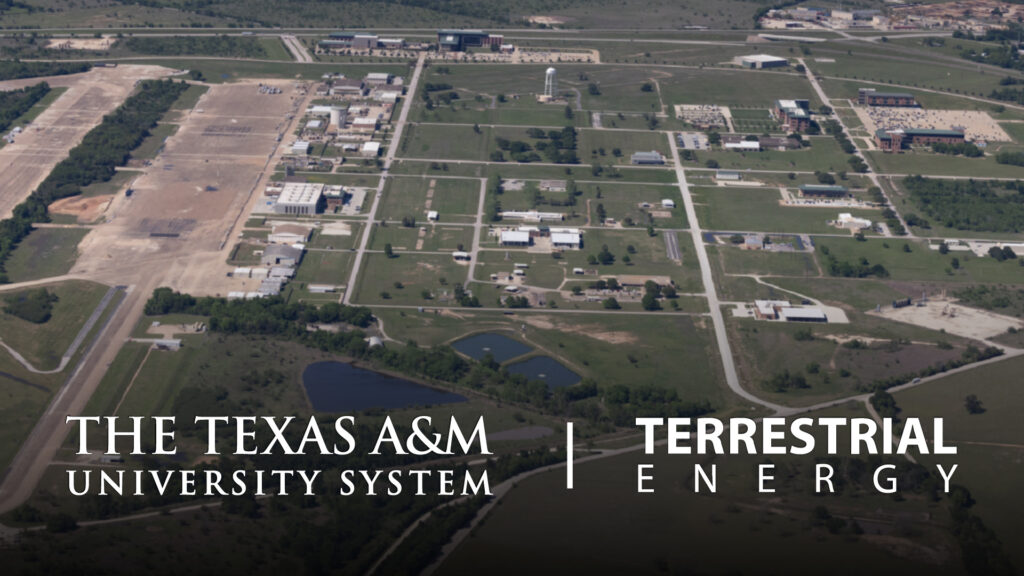
BRYAN-COLLEGE STATION, Texas — America’s race to build the next generation of nuclear energy is accelerating at Texas A&M-RELLIS, where The Texas A&M University System signed agreements with Terrestrial Energy Inc. to advance the development of its planned small modular reactor.
The ground lease and research agreements give Terrestrial Energy site control over approximately 77 acres at A&M-RELLIS and support site characterization, environmental evaluations, testing and research activity connected to the company’s Integral Molten Salt Reactor (IMSR).
The work follows a 2025 memorandum of understanding between the A&M System and Terrestrial Energy after the company joined the RELLIS Energy Proving Ground initiative.
“President Trump has made clear that America needs to move faster to develop the next generation of nuclear energy,” said Board Chairman Robert L. Albritton. “Texas is ready to help lead that work. At the RELLIS campus, the A&M System has the land, research capacity and workforce mission to help move important energy technologies into the commercial world. This work can strengthen our state, our economy and our national security.”
The A&M System created the RELLIS Energy Proving Ground to give advanced energy companies access to land for planning demonstrations and commercial operations, research expertise, testing capacity and workforce partnerships within one of the nation’s largest public university systems.
At A&M-RELLIS, companies can pursue project siting, licensing, testing and development work needed to move advanced nuclear energy technologies into nationwide commercial use.
The U.S. Department of Energy also selected Terrestrial Energy for its Reactor Pilot Program, a federal effort announced in 2025 after President Trump’s Executive Order 14301 to accelerate the testing of advanced reactor designs outside the national laboratories.
Texas and the nation face growing electricity demand driven by population growth, advanced manufacturing, data centers, artificial intelligence and other energy-intensive industries.
“The Texas A&M System was built to solve problems that matter to Texas and the nation,” said Chancellor Glenn Hegar. “Reliable power is one of those problems. At A&M-RELLIS, we are bringing industry, researchers and public partners together to work on practical energy solutions that can support growth, strengthen the grid and prepare students for high-demand careers.”
The work also strengthens Bryan’s role as a home for advanced energy development.
“Energy is the catalyst for everything that drives our state and nation forward,” said Bryan Mayor Bobby Gutierrez. “These critical challenges are courageously studied and tested every day at the RELLIS campus, making our community a world-class destination for advancing new technology. The City of Bryan is honored to help solve these challenges by supporting investments from companies like Terrestrial Energy.”
Terrestrial Energy is developing a small modular reactor using its Generation IV IMSR technology, which the company says can provide reliable heat and electricity for industrial and power-generation uses.
The agreements at A&M-RELLIS support completion of site characterization work, project development and testing activities tied to the company’s commercial plans. They also support research and development activity connected to Terrestrial Energy’s Department of Energy partnership projects, known as TETRA and TEFLA.
Terrestrial Energy has opened an engineering and project management office at the RELLIS campus to help direct the company’s work with the A&M System and other partners.
The Terrestrial Energy agreements follow another recent milestone at the RELLIS campus. In May, Last Energy announced that the U.S. Department of Energy approved the Preliminary Documented Safety Analysis for its PWR-5 pilot reactor project at the campus.
The projects are part of the A&M System’s broader effort to make A&M-RELLIS a national hub for advanced energy research, testing and workforce development.
Texas A&M-RELLIS, located in Bryan, was designed as an applied research and technology campus where universities, state agencies and private-sector partners can work together on complex problems in fields such as energy, national security, transportation, advanced manufacturing and workforce development.