Texas A&M-Fort Worth Opens First Academic Building, Breaks Ground on Next Phase of Downtown Campus
•
min. read
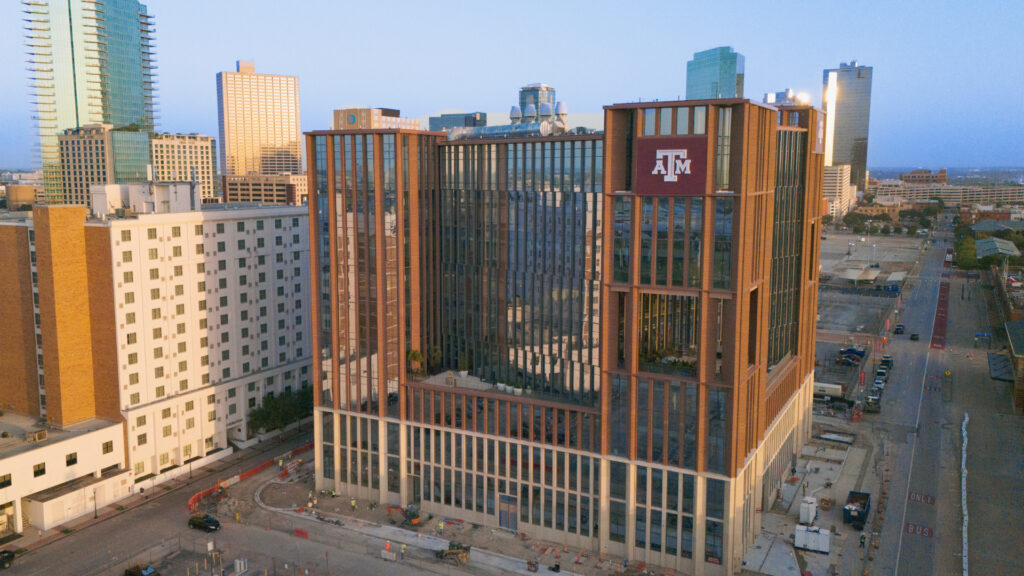
Dual celebration marks two major milestones, with interactive exhibits highlighting academics, research and innovation
FORT WORTH, Texas — The Texas A&M University System officially opened its new downtown Fort Worth campus Wednesday and immediately began work on the next phase of a long-term investment in the city’s students, workforce and economy.
Texas A&M-Fort Worth welcomed A&M System Regents, Chancellor Glenn Hegar, System leaders, faculty, staff and community partners to celebrate the grand opening of the eight-story, 228,000-square-foot Law & Education Building. The ceremony concluded with the groundbreaking of the Research & Innovation Building-A, a facility designed to bring university researchers, state agencies and private-sector partners together.
The two buildings will serve as the academic and research anchors of the Switchyard Innovation District, a planned hub for education, research, entrepreneurship and business collaboration in southeast downtown Fort Worth. Planning for Texas A&M-Fort Worth was driven by a comprehensive needs assessment that helped identify the programs, research and partnerships needed to address the region’s evolving workforce needs. Additionally, an economic impact study projects that, upon completion, the campus will support more than 25,000 direct and indirect jobs and generate more than $3 billion in annual economic activity.
“Growth takes skilled people, sound infrastructure, useful ideas and partners willing to invest for the long haul,” said Robert L. “Bob” Albritton, chairman of The Texas A&M University System Board of Regents. “Texas A&M-Fort Worth brings those things together in one place.”
This is not simply another downtown building or a collection of academic programs. It is a place where a student can meet a future employer, a researcher can sit across the table from a company facing a real problem and a good idea can become a product, a business or a job.”
ACADEMICS ACROSS DISCIPLINES
The Law & Education Building will house academic programs from Texas A&M University and Tarleton State University.
The new building is home to the A&M School of Law and other programs including engineering, business, healthcare, pharmacy, biotechnology and medical laboratory sciences. Students learn alongside researchers, public service professionals and industry partners while gaining hands-on experiences that prepare them to lead in rapidly evolving industries.
Six Texas A&M System agencies also call the building home, extending learning beyond the classroom through applied research, technology development and public service.
“This is not simply another downtown building or a collection of academic programs,” said Glenn Hegar, chancellor of The Texas A&M University System. “It is a place where a student can meet a future employer, a researcher can sit across the table from a company facing a real problem and a good idea can become a product, a business or a job.”
INTERACTIVE DISPLAYS SHOWCASE ACADEMICS, RESEARCH AND INNOVATION
Following the ceremony, guests and media explored interactive displays and immersive demonstrations showcasing academics, research and innovation in action. Highlights included engineering and robotics demonstrations featuring advanced manufacturing technologies, advanced aviation and transportation research, immersive nursing simulation suites and the Mobile Health Assessment Center.
“These experiences reflect how learning happens at Texas A&M-Fort Worth,” said Bobby Ahdieh, chief operating officer of Texas A&M-Fort Worth and dean of the Texas A&M University School of Law. “Students don’t just earn degrees. They engage with researchers, public service professionals and industry partners, gaining the experience, connections and perspective to lead in rapidly changing fields”
BUILDING WHAT’S NEXT
Immediately following the grand opening, leaders broke ground on the Research & Innovation Building-A, an 11-story facility that will expand opportunities for university researchers, Texas A&M System agencies and private-sector partners to collaborate in aerospace, engineering, agriculture, health sciences, virtual production, medicine, food and nutrition science, biotechnology and transportation. Scheduled for completion in 2029, the building will expand the campus’s research capabilities and strengthen the emerging Switchyard Innovation District as a hub for innovation, workforce development and economic growth.
“Today’s celebration marks the beginning of what’s ahead for Texas A&M-Fort Worth,” said Kim McCuistion, associate vice chancellor and director of Texas A&M-Fort Worth. “Together, we’re building a unique campus where universities, state agencies and industry partners work side by side to prepare students, advance research and solve real-world challenges.”
EDITOR’S NOTE: LAW & EDUCATION BUILDING AT A GLANCE
Building Facts
- First completed building on the Texas A&M-Fort Worth downtown campus
- Eight stories
- 228,000 square feet
- Home to academic programs from Texas A&M University and Tarleton State University
- Home to six Texas A&M System agencies
Programs
Texas A&M University
- School of Law
- College of Engineering
- College of Performance, Visualization and Fine Arts
- Mays Business School
- Texas A&M Health
- Naresh K. Vashisht College of Medicine
- Irma Lerma Rangel College of Pharmacy
Tarleton State University
- Health sciences
- Biomedical sciences
- Biotechnology
- Biotechnology Research and Innovation Institute
- Medical laboratory sciences
- Office of Extended Education and Workforce Development
Texas A&M University-Corpus Christi
- Center for Advanced Aviation Technologies
Texas A&M System Agencies
- Texas A&M AgriLife Research
- Texas A&M AgriLife Extension Service
- Texas A&M Engineering Experiment Station
- Texas A&M Transportation Institute
- Texas A&M Engineering Extension Service
- Texas Division of Emergency Management
Interactive Displays
- Industrial robotic arm demonstrations and workforce training activities presented by the Texas A&M Engineering Experiment Station (TEES)
- Advanced aviation, Digital Twins, AI and transportation research showcasing the future of mobility
- Mobile Health Assessment Center tours and interactive health exhibits
- Advanced nursing simulation labs and healthcare diagnostics demonstrations
- 3D medication printing, biotechnology and biomedical sciences showcases
- Innovation Corridor highlighting the future of Texas A&M-Fort Worth, the Fort Worth-Tarrant County Innovation Partnership and the Switchyard Innovation District