Texas A&M System Regents Advance Semiconductor Institute With New Texas A&M-RELLIS Water Tower
•
min. read
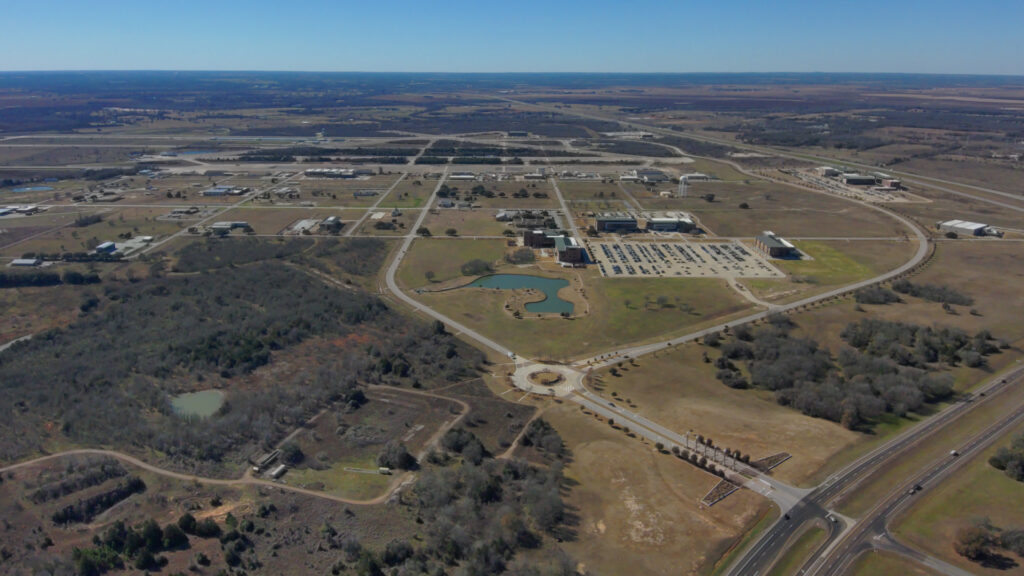
One-million-gallon tower will support $205.5 million semiconductor project and future campus growth
BRYAN-COLLEGE STATION, Texas — The Texas A&M University System Board of Regents on Thursday approved construction of a new 1-million-gallon water tower at the RELLIS Campus, clearing another critical infrastructure phase for the Texas A&M Semiconductor Institute and continued development across the campus.
The $11.755 million tower will replace the 300,000-gallon structure built to serve the former military airfield. The existing tower maintains water pressure of approximately 51 to 55 pounds per square inch, which is no longer sufficient to efficiently support newer facilities and planned growth.
New buildings currently require separate pumps to meet fire-protection and irrigation requirements. The larger tower will more than triple storage capacity while providing the pressure needed by the Semiconductor Institute and other projects envisioned in the A&M-RELLIS master plan.
“Semiconductor research and fabrication require extraordinary precision, but they still depend on reliable basic infrastructure,” said Robert L. Albritton, chairman of the Board of Regents. “A water tower may not be the glamorous part of this project, but it is the part that makes everything else possible. Texas is serious about bringing semiconductor capability home, and the A&M System is building for it.”
Construction of the tower is scheduled to begin in September and reach substantial completion in March 2028. The Board’s action includes a new appropriation of approximately $10.58 million. About $1.18 million had been appropriated previously for the tower phase.
The overall Texas A&M Semiconductor Institute, infrastructure and equipment project has a budget of $205.5 million. The Institute building and related storm drainage work, previously approved by the Board, account for approximately $177.95 million of that total.
Construction of the Institute building began in March. Substantial completion is scheduled for January 2028, with occupancy expected in May 2028.
The Texas A&M Semiconductor Institute is being developed as a national shared-use facility to advance semiconductor materials, specialized tools and domestic chip fabrication. The project is intended to support research collaboration, strengthen the Texas economy and help restore semiconductor capacity in the United States.
A separate $15.8 million water-well infrastructure phase is expected to return to the Board for construction approval later this year.
About The Texas A&M University System
The Texas A&M University System is one of the largest and most impactful higher education systems in the country, with an annual budget of $9.1 billion. Its statewide network includes 12 universities, a comprehensive health science center, eight state agencies, Texas A&M–Fort Worth and the Texas A&M–RELLIS Campus. The A&M System also plays a direct role in U.S. national security as a member of the teams that manage and operate Los Alamos National Laboratory and the Pantex Plant for the U.S. Department of Energy’s National Nuclear Security Administration. The A&M System serves approximately 175,000 students and reaches millions more through research, service and outreach programs each year. With nearly $1.6 billion in annual research expenditures, the A&M System fuels innovation, supports communities and drives Texas’ economy forward.
Media Contact:
Chris Bryan
Vice Chancellor of Marketing and Communications
cbryan@tamus.edu