The Texas A&M System: Building to Lead in Space
•
min. read
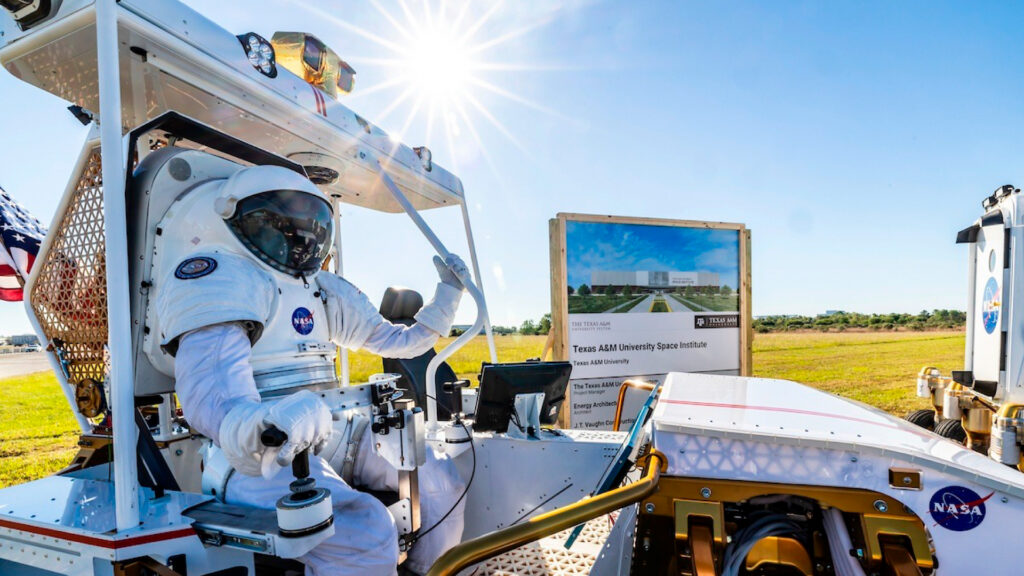
The Texas A&M University System is quickly building one of the most expansive university-led space enterprises in the United States. From microbes floating in orbit to a $200 million lunar training ground rising next door to NASA’s Johnson Space Center, A&M System members are advancing astronaut training, radiation protection, satellite engineering, autonomous systems, and workforce development. Together, they are helping position Texas and the United States at the forefront of the next era of space exploration while preparing the workforce needed to sustain it.
TEXAS A&M UNIVERSITY SPACE INSTITUTE
The Texas A&M University Space Institute will be the centerpiece of the A&M System’s growing space enterprise. Set to open in fall 2026, the first-of-its-kind research facility is rooted in collaboration, discovery, and training, bringing government entities and private-sector partners together under one roof to perform space-related research side by side. The institute is being built in NASA’s Exploration Park, a 240-acre property adjacent to Johnson Space Center in Houston, and will be the first tenant in that development. It is funded through a $200 million initial investment from the State of Texas, part of a $350 million space and aeronautics package approved by the Texas Legislature in 2023.
The 400,000-square-foot facility will house the world’s largest indoor lunar and Martian surface simulations, high-bay laboratories, research garages, and multifunctional project rooms. It is led by Director Dr. Nancy Currie-Gregg, a former astronaut with four space shuttle missions and roughly 1,000 hours in space, alongside Associate Director Dr. Robert Ambrose. Early private-sector partners include lunar-rover developer Venturi Astrolab and lunar-lander company Intuitive Machines. When it opens its doors, the Space Institute will support applied research and development, planetary science, mission concept development and training, and workforce development, establishing Texas as the global leader in advancing humanity’s future in space.
TEXAS A&M-RELLIS
Texas A&M-RELLIS provides the physical infrastructure that connects the A&M System’s space ambitions to real-world testing and development. The campus is home to the Detonation Research Test Facility, the largest academic controlled-explosions lab in the world, where aerospace researchers Dr. Elaine Oran and Dr. Scott Jackson study how flames accelerate and transition into full detonations at speeds exceeding Mach 5. The research has direct applications to next-generation space propulsion, including rotating detonation engines that could reshape how spacecraft generate thrust, as well as the formation of nanodiamonds under extreme pressures for use in aerospace materials. The Ballistic, Aero-Optics and Materials (BAM) Range, a half-kilometer enclosed test range, supports experimental testing for both national security and space exploration, while a new Hypersonic Wind Tunnel under construction will provide large-scale aerodynamic testing in the Mach 5 to 9 range, becoming the largest academic facility of its kind in the country. Together, these facilities allow researchers to test materials, propulsion concepts, and aerodynamic designs under extreme spaceflight conditions without leaving Central Texas.
RELLIS is also where Dr. Robert Ambrose, who spent decades at NASA’s Johnson Space Center leading the development of Robonaut and lunar rover prototypes, now runs the Texas A&M Robotics and Automation Design Lab and serves as associate director of the Texas A&M Space Institute. The campus operates autonomous systems on land, in the air, and in the water, capabilities that directly support robotic exploration of the Moon and Mars. Open to researchers across the A&M System, and to government and private-sector partners, RELLIS is the testing ground where space technologies move from concept to hardware.
TEXAS A&M UNIVERSITY
As the largest space-grant university in Texas, Texas A&M has a long history of conducting basic and applied research and workforce development in space exploration. Faculty are at the forefront of earth and planetary sciences, human spaceflight research, and planetary surface engineering and construction. Scientists and engineers from Texas A&M have contributed to every NASA Mars rover mission, and two scientists are active on NASA’s Perseverance Rover Team. Texas A&M supports more than 300 active space-related projects, counts more than 400 former students among NASA’s workforce, and is home to five former astronauts: Dr. Nancy Currie-Gregg, Dr. Gregory Chamitoff, Dr. Bonnie Dunbar, Col. Michael E. Fossum ’80, and Dr. Serena Auñón-Chancellor. At Governor Greg Abbott’s urging, Texas A&M launched a Master of Engineering in Space Engineering in fall 2025, preparing the next generation of engineers to help humanity explore and thrive in space and on other celestial bodies while advancing space security.
Beyond engineering, Texas A&M researchers are making advances in everything from aerospace medicine to low-gravity agriculture to geology to astronaut psychology and more. Texas A&M is committed to leading the future of space exploration, becoming a recognized hub and center of excellence for human and robotic space exploration by leveraging expertise, laboratories, strategic partnerships, and resources to foster new discoveries, technological innovations, and a next-generation workforce that benefits Texas and society.
PRAIRIE VIEW A&M UNIVERSITY
Prairie View A&M University is advancing NASA’s most critical missions through groundbreaking research and student-centered innovation. Dr. Matthew Minus, assistant professor of chemistry, secured nearly $200,000 in NASA funding to lead a three-year Earth science initiative that expands research capacity while opening access to NASA-related learning and data for more students. Dr. Shield Lin, professor of mechanical engineering, has led NASA-supported research on flight software verification for the Lunar Gateway, the planned orbital station that was part of NASA’s Artemis architecture before the agency shifted its lunar strategy toward surface-based infrastructure in early 2026. The work created hands-on learning experiences for students in computer science and engineering applying classroom knowledge to real-world spaceflight challenges, and the software and simulation expertise developed through the project remains directly relevant to NASA’s evolving lunar mission portfolio.
TARLETON STATE UNIVERSITY
TEXAS A&M INTERNATIONAL UNIVERSITY
Texas A&M International University is expanding access to space science education in South Texas and beyond. TAMIU recently reopened its Lamar Bruni Vergara Planetarium, now home to the Sonia and Memo Benavides Immersive Theatre, featuring enhanced high-resolution, full-dome presentations that support astronomy-based learning, public engagement, and STEM outreach across the binational region. TAMIU participates in the Center for Space Technologies (CSTx), a statewide collaborative investment funded by the Texas Space Commission and anchored within the Rice Space Institute to advance space-related research, innovation, and workforce development. Through CSTx, TAMIU supports Mission Antares 1, a five-day immersive STEM program for students in grades 4 through 6 developed with the United Independent School District and the Boys & Girls Club of Laredo. The program connects early exposure to space science, engineering, and data-driven problem solving with long-term STEM pathways through hands-on experiences in the planetarium, robotics labs, and outdoor mapping environments. TAMIU is also advancing the Future Astronaut Trail, an AI-enabled, multilingual learning experience developed with Fun Learning Campus Finland and in partnership with NASA, through its Office of Global & Community Engagement. The free, place-based experience engages children and families in interactive missions promoting literacy, critical thinking, and curiosity about space, beginning at the Benavides Immersive Theatre with 24/7 access and expanding internationally to Rwanda and Mexico through a partnership with TecMilenio.
TEXAS A&M UNIVERSITY-CORPUS CHRISTI
Texas A&M University-Corpus Christi faculty and students are contributing to space research and innovation across multiple disciplines. Dr. Jose Baca was selected as an alternate crew member for NASA’s Human Exploration Research Analog (HERA) program, which simulates the challenges astronauts face during long-duration space missions, while Dr. Ron Snarr, an associate professor of exercise physiology, is training as an aspiring astronaut and connecting his kinesiology expertise to spaceflight applications. Student Aleena Roy responded to a NASA competition by designing a compression garment to address cardiovascular issues for both astronauts in space and patients on Earth. A&M-Corpus Christi researchers are also advancing atmospheric and Earth observation science with space-related applications. Students under Dr. Chuntao Liu launched weather balloons during a solar eclipse to gather atmospheric data and analyze changes in key parameters, while the university’s NSF-funded coastal research center integrates satellite imagery, drone sensing, and AI-driven geospatial computing to improve coastal monitoring and resilience decision-making.
TEXAS A&M UNIVERSITY-KINGSVILLE
Texas A&M University-Kingsville is expanding The Texas A&M University System’s aerospace and workforce development pipeline through a new Master of Science in Space and Aeronautical Engineering launching in fall 2026. The program combines traditional aerospace engineering principles with emerging technologies in space exploration, satellite systems, astrodynamics, propulsion, and hypersonics, giving students hands-on preparation for careers in the rapidly evolving space and defense sectors. Designed with both thesis and non-thesis pathways, the program supports a broad range of students, from researchers pursuing doctoral studies to working professionals and fast-track engineering students seeking advanced technical training. Coursework includes advanced aerodynamics, aerospace dynamics and control, aerospace propulsion, computational fluid dynamics, composite materials, and advanced manufacturing, while emphasizing project-based learning and real-world problem solving tied to aviation, spacecraft systems, and national laboratory applications.
EAST TEXAS A&M UNIVERSITY
At East Texas A&M University, space research is anchored in the Department of Physics and Astronomy, where faculty and students are advancing discovery through NASA collaborations, published research on planetary systems and exomoons, and work that reaches from habitable-zone exoplanet searches to the dynamics of moons around distant stars. Under the leadership of department head Dr. Kurtis Williams, students gain hands-on experience through observatories, planetarium programming, and remote telescope networks, while undergraduate researchers contribute directly to projects led by faculty. That impact reaches even Mars, where the International Astronomical Union named Blount Crater, a nearly 48-mile-wide feature near the Hellas Basin, in honor of the late East Texas A&M University professor Dr. Katherine “Kit” Blount, recognizing her contributions to planetary mapping and her work with NASA-led efforts studying ancient Martian river valleys.
TEXAS A&M UNIVERSITY-SAN ANTONIO
At Texas A&M University-San Antonio, space research is taking shape through the work of Dr. Alba Chavez, an incoming assistant professor of biology whose background in microbiology centers on space microbiology and the biological challenges of human spaceflight. Dr. Chavez studies how microbial biofilms respond to microgravity exposure and is investigating antibiotic resistance with the goal of identifying drug repurposing agents that could support aerospace and space exploration efforts. Her work also includes fungal strains isolated from the International Space Station, where she has worked to identify pathogenic phenotypes that might pose risks to astronauts. Dr. Chavez is expected to join the A&M-San Antonio faculty beginning in fall 2026, establishing the university as an emerging contributor to the life sciences side of The Texas A&M University System’s growing space enterprise.
TEXAS A&M AGRILIFE
Texas A&M AgriLife Research is helping solve some of the most fundamental challenges of long-duration spaceflight: how to feed astronauts and how to grow food beyond Earth. The Space Food Research Facility on the Texas A&M campus is the only facility of its kind in the United States, where food scientists from the university and NASA work side by side to develop and prepare ready-to-eat meals for astronauts in orbit. Since 2005, AgriLife Research has played an integral role in enabling NASA’s Johnson Space Center to prepare food for its astronauts, and AgriLife’s National Center for Electron Beam Research is advancing eBeam processing as a next-generation method for sterilizing and preserving space food. AgriLife researchers are also pioneering lunar agriculture. A Texas A&M graduate student achieved a world first by growing chickpeas in a mixture of up to 75% simulated moondust, using fungi and worm manure to transform the nutrient-poor regolith into viable growing material, research that could reduce the need for resupply missions and open the door to sustainable food production on the Moon. Meanwhile, AgriLife crop physiologist Dr. Nithya Rajan is testing sensors for deployment in spaceflight or lunar habitats as part of a NASA-funded project to detect and monitor plant stress in controlled growth environments, work that could inform how crops are managed both in space and in resource-limited conditions on Earth.
TEXAS A&M TRANSPORTATION INSTITUTE
The Texas A&M Transportation Institute (TTI) is bringing its transportation expertise to the A&M System’s space enterprise through a partnership with the Texas A&M University Space Institute, aimed at positioning Texas and the nation in the growing space economy. TTI Agency Director Greg Winfree argues that “spaceways” belong alongside roads, rails, waterways, and airways in a nation’s transportation network. Long-term lunar and Martian habitation will depend on practical transportation and construction answers, including whether naturally occurring regolith could pave roads on the Moon. The Space Institute’s two football-field-sized lunar and Martian surface simulations will give researchers a place to test ideas like these before they leave earth.
Want to learn more about space-related research across The Texas A&M University System? Explore the Office of Research Space Affinity Group to connect with faculty, researchers, facilities, and initiatives advancing astronomy, aerospace, in-space operations, and other space-focused disciplines across our member institutions.